

Corona Test Inks
You can rely on AFS. Always.
Corona Test Inks
Measuring of the Surface Tension
The adhesive strength of a surface usually depends on its surface tension. In case the surface tension of a surface is much lower than the surface tension of the used ink, the wetting is disrupted. This results in a poorer adhesion.
For this reason the film which has to be printed needs a defined surface tension depending on the respectively used printing ink:
- Solvent based inks => 38 up to 42 mN/m (=dyne/cm)
- Water based inks => 40 up to 44 mN/m
- UV-inks => 44 up to 46 mN/m
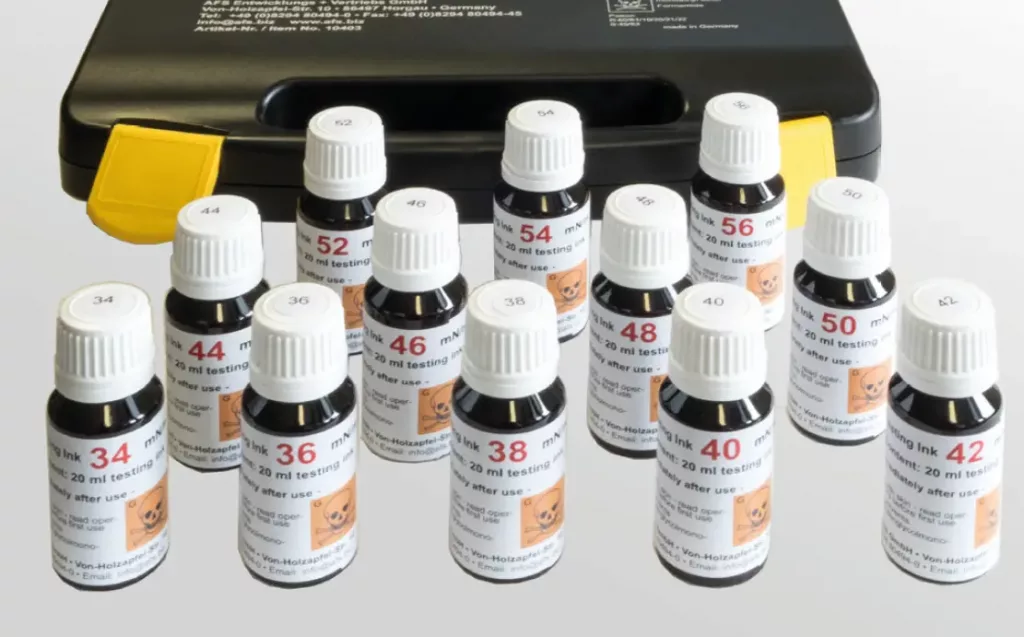
Testing with AFS Corona Test Inks
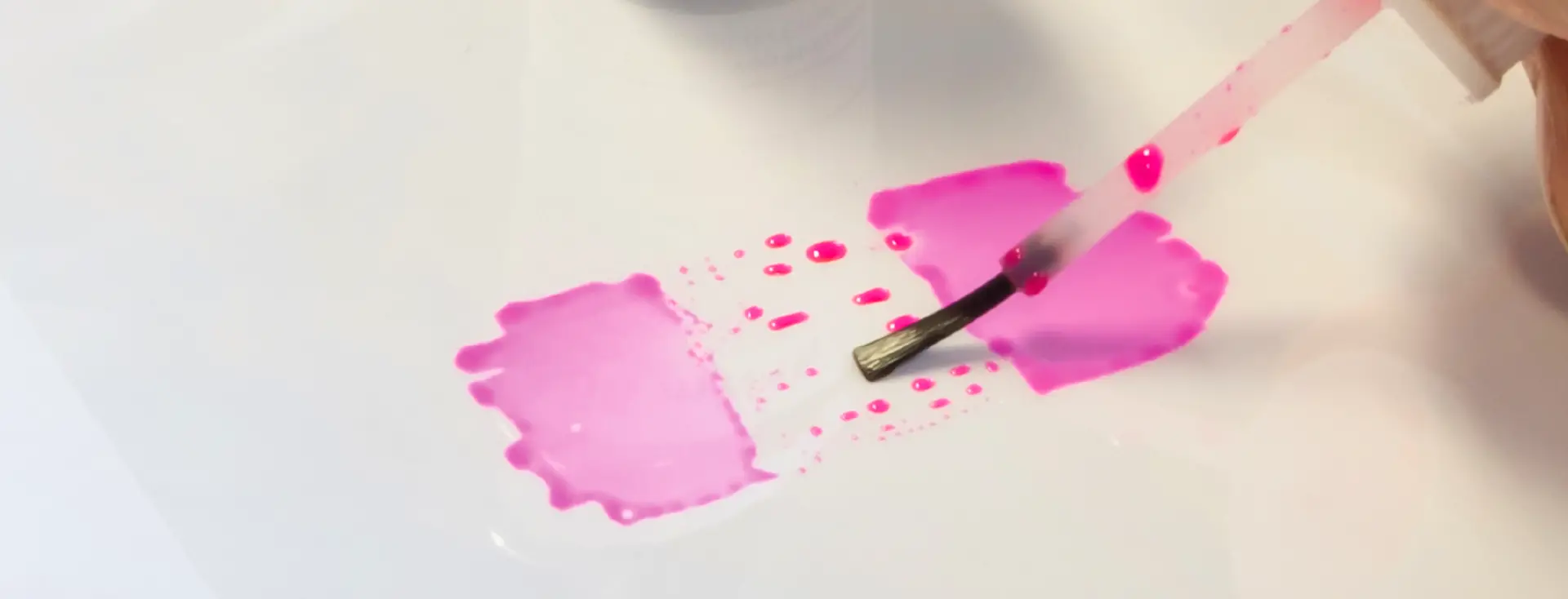
In contrast to the Quick-test pen, which indicates the printability of a film with solvent based ink only, using the AFS Corona test inks it is possible to measure the precise dyne-level of the film surface. These test inks consist of a different chemical composition and are not wiping resistant. Put the test sample of the film on a smooth and clean surface and draw a line with the test ink on the sample:
- If the test liquid remains smoothly on the material surface for more than 2 seconds without fragmenting: It can be assumed that the dyne level is at least as high as thevalue marked on the pen or bottle.To establish the exact value of surface tension, thetest should be repeated with inks of ever-increasing dyne values, until a point is reached where the liquid starts to break apart in less than 2 seconds. The correct surface tension value is the first measurement where the liquid just holds together for 2 seconds before starting to fragment.
- If the test liquid is fragmenting immediately: The test should be repeated with inks of ever-decreasing dyne values, until the ink remains smoothly on the material surface forat least 2 seconds. Then this is the correct value of the surface tension.
Application
The measurement is valid at a room temperature of 23°C, with a relative humidity of approx. 50%.
It is important to note that when measuring the surface tension on non-polymer materials, an increase in the dyne value does not necessarily mean an increase in adhesive strength. Our contact-angle measurment system and other test methods will perform a moredetailed analysis on such surfaces. The chemical composition of our standard test inksand pens are based on DIN ISO 8296 (taken from the original Union Carbide standard).
Our standard products have a shelf-life of 6 months after opening and 12 months unopened.
Request now
Let our AFS service team assist you
AFS at a glance
- AFS systems are designed for smooth continuous operation.
- AFS only uses high-quality components from selected suppliers in all its systems.
- AFS products are recognized industry standard.
- AFS offers a full two-year warranty.
- AFS is the preferred partner of OEMs, global players and quality-conscious end customers.
We are looking forward to your inquiry
More contact options
Telephone: +49 (8294) 80494-0
Fax: +49 (8294) 80494-45
Mail: info@afs.biz
Von-Holzapfel-Straße 10
86497 Horgau